The News
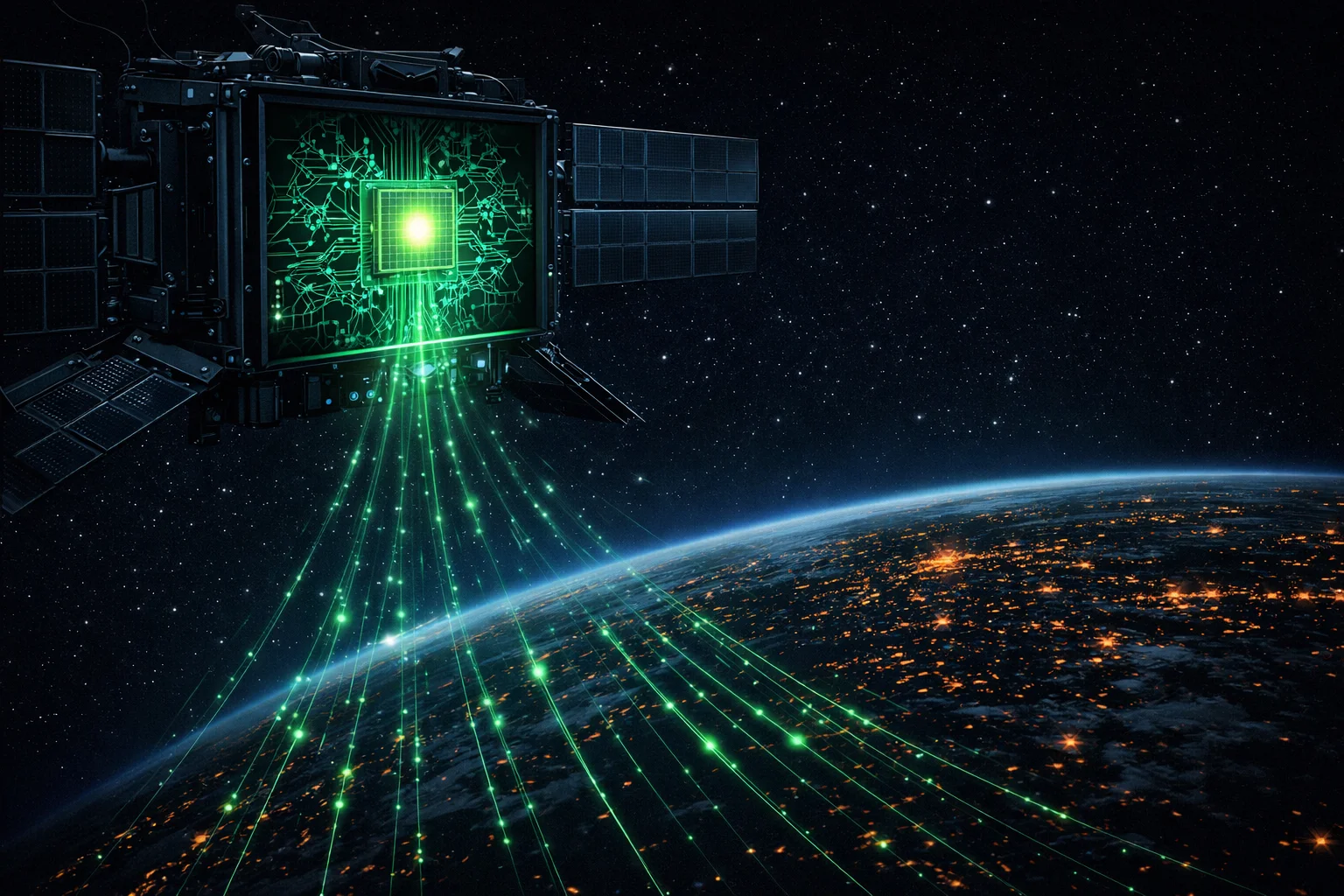
Nvidia announced the Space-1 Vera Rubin Module at its GTC conference in San Jose on March 16 — a computing system designed specifically for satellites and orbital data centers. The module combines Nvidia’s IGX Thor and Jetson Orin platforms into a package engineered for the realities of space: power constraints, radiation exposure, and thermal management without the luxury of atmosphere.
The system is designed to deliver more computing power than Nvidia’s H100 GPU, which is already the workhorse chip behind most of Earth’s AI infrastructure. Six companies were named as early partners: Aetherflux, Axiom Space, Kepler Communications, Planet Labs, Sophia Space, and Starcloud — which launched the first H100 GPU into orbit in November 2025.
“Space computing, the final frontier, has arrived,” said Nvidia CEO Jensen Huang. “As we deploy satellite constellations and explore deeper into space, intelligence must live wherever data is generated.”
Why It Matters
This is a bigger deal than it sounds. Right now, most satellites are cameras: they collect data, downlink it to Earth, and humans or ground-based computers process it. The bottleneck is bandwidth — there’s far more data being generated in orbit than can be transmitted to the ground. Earth observation constellations like Planet Labs photograph the entire planet daily, generating petabytes of imagery that has to be prioritized, compressed, and queued for downlink.
Putting AI processing directly on the satellite changes the architecture. A satellite with onboard AI can analyze imagery in real time, detect changes, classify objects, and only transmit what matters — cutting downlink bandwidth by orders of magnitude. For defense and intelligence applications, this means faster decision cycles. For commercial Earth observation, it means more actionable data delivered faster. For deep-space missions, where communication delays make real-time ground control impossible, it means spacecraft that can think for themselves.
The fact that Nvidia — the most valuable semiconductor company on Earth — is building purpose-designed space hardware signals that orbital computing is moving from experiment to industry. When Nvidia builds for a market, the ecosystem follows: toolchains, developer communities, training programs, and jobs.
Career Connection
This announcement sits at the intersection of software and space — a combination that barely existed five years ago and is now one of the fastest-growing areas in aerospace:
- Aerospace Engineering — Radiation-hardened computing, thermal management without convection, and power-constrained system design are core spacecraft engineering challenges. The Space-1 module needs engineers who understand both chip architecture and orbital environments.
- Avionics Technician — Integrating AI computing modules into satellite buses, testing radiation tolerance, and managing power and data buses on orbit requires hands-on avionics and electronics expertise.
- Space Operations — Onboard AI changes how satellites are operated — less data downlink management, more autonomous tasking and mission planning. Operators need to understand what the AI is doing and when to intervene.