The News
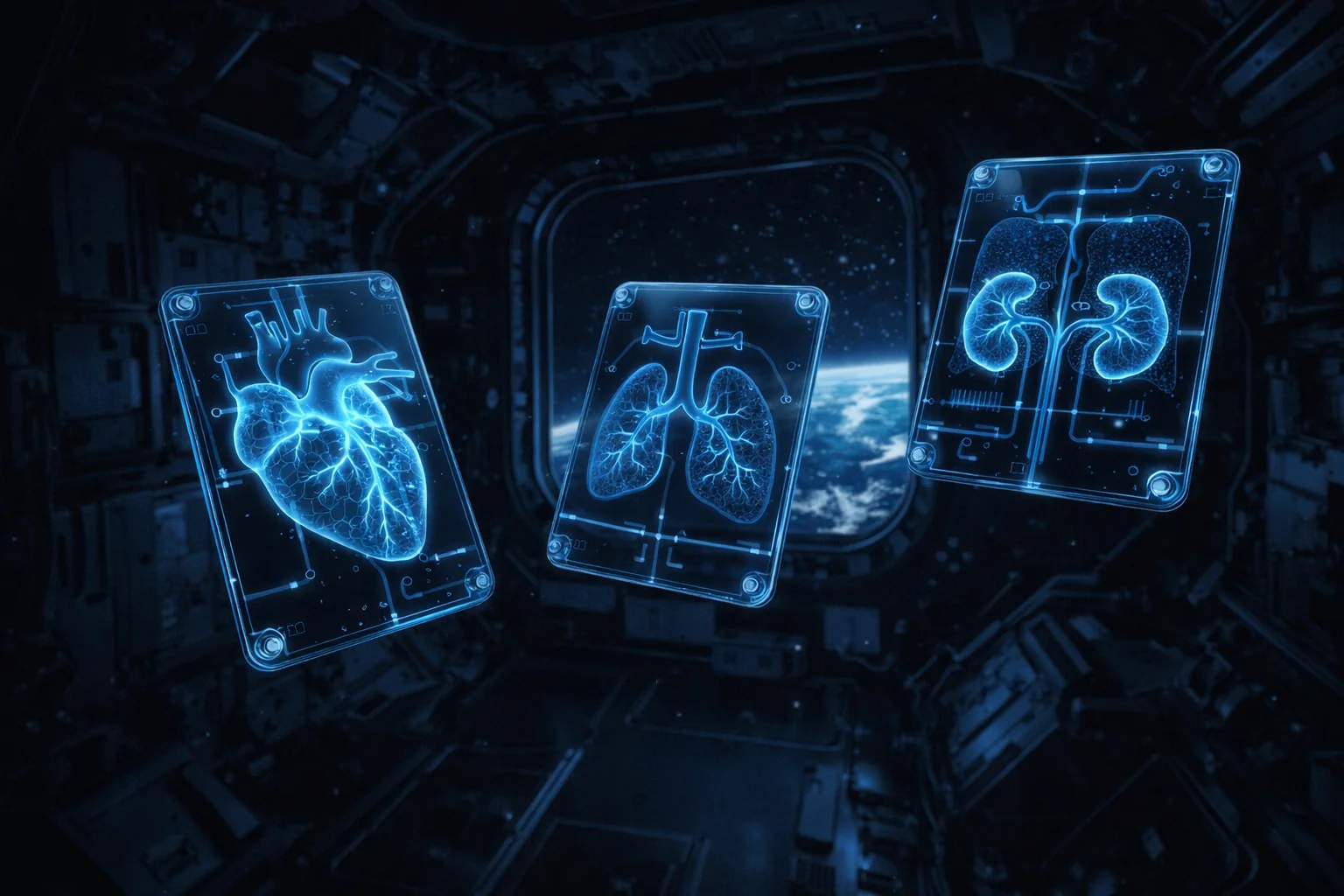
NASA and the National Institutes of Health have spent nearly a decade developing tissue chips — miniature, lab-grown models of human organs that can be sent to space instead of people. These microphysiological systems replicate how human lungs, hearts, and other organs respond to conditions like cosmic radiation and microgravity, fitting inside something as small as a shoebox aboard an unmanned spacecraft.
The push is driven by a hard problem: NASA’s Artemis program will send astronauts to the Moon for longer than any Apollo mission, exposing them to deep-space radiation that can’t be effectively shielded or realistically studied on Earth. Traditional research using animal models has a poor track record — nearly 90% of clinical trials fail despite promising results in mice. Tissue chips built from actual human cells bypass that species gap entirely.
The Translational Research Institute for Space Health (TRISH), based at Baylor College of Medicine, is leading much of this work in partnership with NCATS and the Center for the Advancement of Science in Space. Recent advances now allow multi-organ chip systems that can study how radiation affects interconnected body systems — not just one organ at a time.
Why It Matters
This is one of those stories that doesn’t make headlines but reshapes an entire career field. As the ISS approaches decommissioning and crewed research time gets scarcer, autonomous biological research platforms become critical infrastructure. The ability to run sophisticated health studies without astronauts present opens up deep-space missions that would otherwise be too risky to approve.
For students, pay attention to the intersection here: this isn’t just biology, and it isn’t just engineering. Tissue chip platforms need biomedical engineers to design them, software engineers to automate them, and mission operations specialists to manage experiments running autonomously millions of miles from Earth. It’s a concrete example of how aerospace careers are expanding beyond traditional rocket science into biotech, health sciences, and lab automation.
Career Connection
If the intersection of space and biomedical science interests you, explore these pathways on AeroEd:
- Aerospace Engineering — Designing the automated experiment platforms and life-support systems that keep tissue chips viable in deep space.
- Space Operations — Managing autonomous experiments aboard uncrewed missions, including data relay and remote diagnostics.
- Astronaut — Understanding the health challenges that tissue chips are designed to solve — the very risks future astronauts will face.